
Article: Not Choosing Just One Path

Not Choosing Just One Path
By Lee Hansheng | Lee Hansheng Studios
There's a question that artists tend to hear throughout their careers: What kind of artist are you?
It's a perfectly reasonable question, but one I've never found particularly easy to answer.
Am I an illustrator? A painter? A printmaker? A ceramicist? A designer?
Well, yes~ I'm an artist.
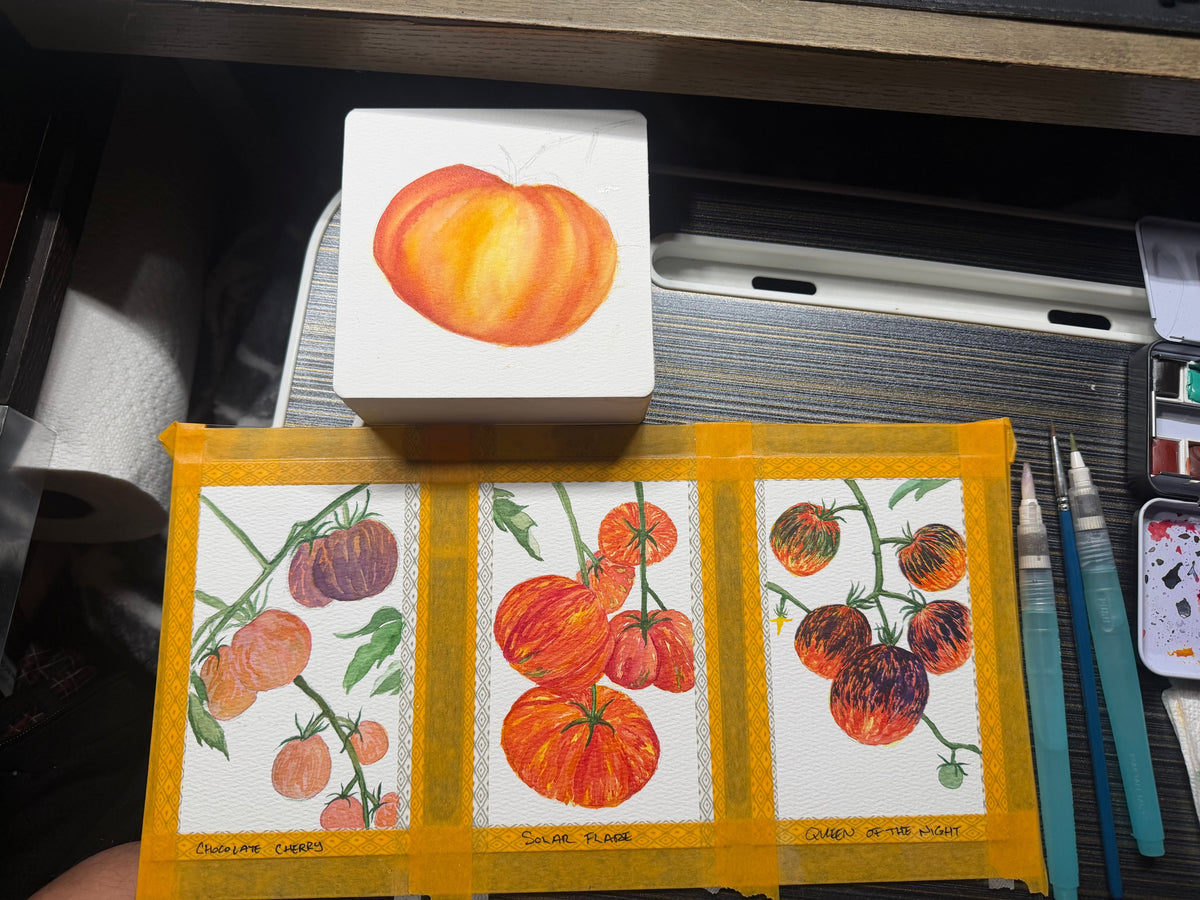
I've spent much of my life working across different mediums, techniques, and creative disciplines. From watercolor and gouache to oil painting, ceramics, stained glass, digital illustration, and a lot of things in between, my artistic practice has never followed a particularly straight line.
And I wouldn't have it any other way~
The Pressure to Pick a Lane
When I first pursued art education, part of my reasoning was that I simply didn't want to choose one discipline over another.
I loved too many things~ and I loved teaching.
There was something fascinating about how different materials behaved, how techniques could influence one another, and how an idea might develop differently depending on the medium used to express it. But somewhere along the way, artists are often encouraged to specialize, pick a lane, choose one. Then there is: Find your style. Establish your niche. Become recognizable for one particular thing~
And while there's definitely value in developing a focused practice, I've never believed that artistic growth requires limiting ourselves to a single form of expression. Sometimes~ most of the time~ interesting discoveries happen when we venture outside what's familiar.
A Practice Built on Curiosity
Over the years, my work has moved through a variety of subjects, styles, and materials.
Some pieces are carefully planned, while others begin with nothing more than a color, a texture, or an idea that refuses to leave me alone.
Lately~ I've been returning to brushwork, experimenting with sumi-e techniques, brush pens, and the relationship between traditional mark-making and contemporary illustration. It's been an interesting reminder that even after decades of working as an artist~ there's always something to learn.
A brush behaves differently from a pen. Ink responds differently from watercolor. A technique that feels effortless at one scale can become surprisingly challenging at another.
The simplest-looking marks require the greatest amount of patience. But that's part of what keeps the process interesting and I've ALWAYS been one for processes~ (Hello Lithograph in college~ LOVED that course.)
Experience Doesn't Mean the End of Experimentation
One of the things I've come to appreciate about having a multidisciplinary background is how often different skills find their way back into my work.
My experience with illustration informs how I approach composition. Painting influences my understanding of color and atmosphere. Printmaking has shaped how I think about line, contrast, and negative space. Even the more technical aspects of design have influenced how I solve visual problems. These disciplines aren't separate compartments in my mind. They're connected, and they continue to inform one another.
That doesn't mean every experiment succeeds~!! (Far from it~!)
Some techniques take longer to develop than expected. Ideas don't translate particularly well from imagination to paper. And occasionally, something that seemed perfectly reasonable in theory turns into a rather entertaining exercise in frustration.
But even those experiences have value~!
We learn something from the things that don't work too~!
Making Room for Change
I think it's easy to become attached to the idea that our creative work needs to remain consistent. That once we've established a recognizable style, we're somehow obligated to maintain it.
But artists are people~ and people change~!
Our interests evolve. Our experiences influence us. The things we want to communicate through our work may look different from one season of life to the next.
I don't see that as a lack of direction~ I see it as part of having a living, evolving artistic practice.
There are periods when I gravitate toward detailed illustration, others when I prefer the freedom of loose brushwork, and still others when I want to step away from painting entirely and work with something three-dimensional. Each has its place~! And each offers something that the others cannot~!
Finding Your Own Creative Rhythm
If there's one thing I'd encourage other artists to remember, it's that you don't have to approach your creative practice the same way someone else does. Some artists find tremendous satisfaction in spending their entire careers refining one medium or subject. Others thrive on experimentation, variety, and the freedom to move between disciplines. Neither approach is inherently better~
What matters is understanding what keeps you curious, engaged, and connected to the work you're creating. And for me~ that has always meant leaving room to explore and breathe~
After all these years, I'm still learning, still experimenting, and occasionally still making an absolute mess of my workspace in the process. I mean I'm currently working on a fold out desk, because my desk is occupied with a laptop, paint easel, and paint palettes.
~ Hansheng
Leave a comment
This site is protected by hCaptcha and the hCaptcha Privacy Policy and Terms of Service apply.